

Denver Museum of Nature & Science, USA
Updating the understanding of Egyptian mummies through explorable CT data
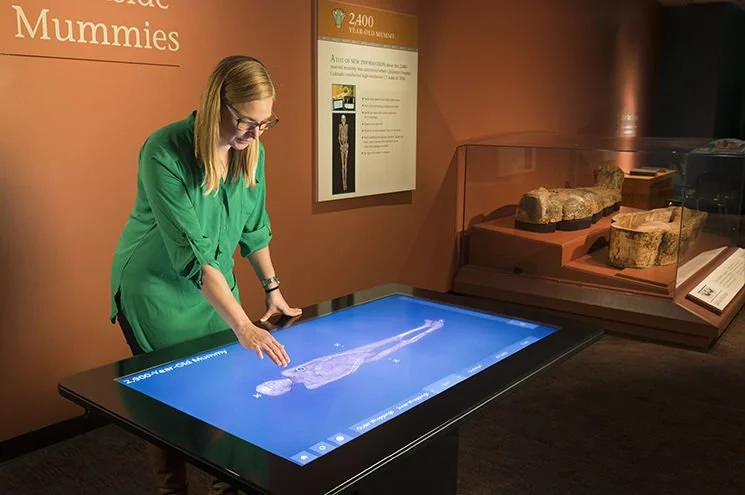
Storyvoxel worked with the Denver Museum of Nature & Science to support the renewal of its Egyptian Mummies exhibition. As part of the redisplay, a 55‑inch Inside Explorer table was introduced, allowing visitors to explore Egyptian mummies through interactive 3D visualisation based on updated scientific imaging.
The installation replaces earlier interpretations derived from scans made in the 1990s, integrating new high‑resolution CT data, radiocarbon dating, and isotope analysis to present a more accurate and nuanced understanding of the individuals behind the wrappings.
The challenge
Advances in imaging and scientific analysis had revealed new details that were not visible in earlier scans. The museum wanted to update the exhibition to reflect current research while making the new findings accessible and engaging for a public audience.
The challenge was to present complex scientific data in a way that preserved accuracy and depth, while remaining intuitive and approachable in a gallery setting.
The Solution
Using Inside Explorer, Storyvoxel transformed updated CT datasets into an interactive experience that allows visitors to peel back layers, explore internal structures, and investigate the mummification process through direct exploration.
The experience is grounded entirely in real scientific data, enabling visitors to engage with the same evidence used by researchers—without relying on illustrations or simplified models.
Experience and impact
Visitors can explore the mummies in detail, gaining clearer insight into their age, health, living conditions, and beliefs. The installation supports deeper understanding by allowing open‑ended, curiosity‑driven exploration rather than fixed narratives.
Since 2012, Storyvoxel has visualised more than 30 mummies from museums and research institutions worldwide. These projects have been deployed across permanent, temporary, and travelling exhibitions, as well as through high‑resolution imagery, video, and 3D‑printed artefacts supporting research and public engagement.
Key outcomes
Updated CT data made explorable in a museum setting
Improved public access to current scientific research
Accurate, data‑driven interpretation replacing outdated scans
Interactive exploration grounded in authentic imaging data
Long‑term reuse of the platform across exhibition formats