
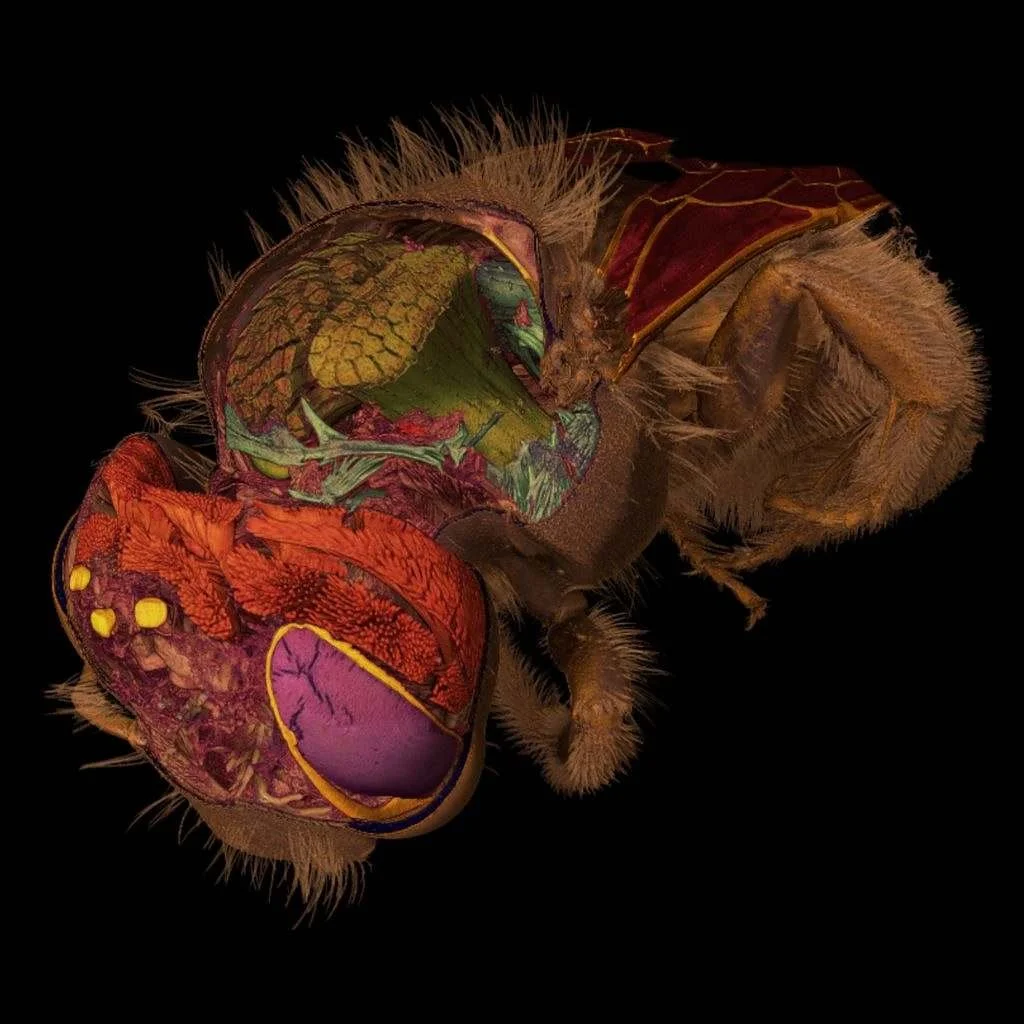
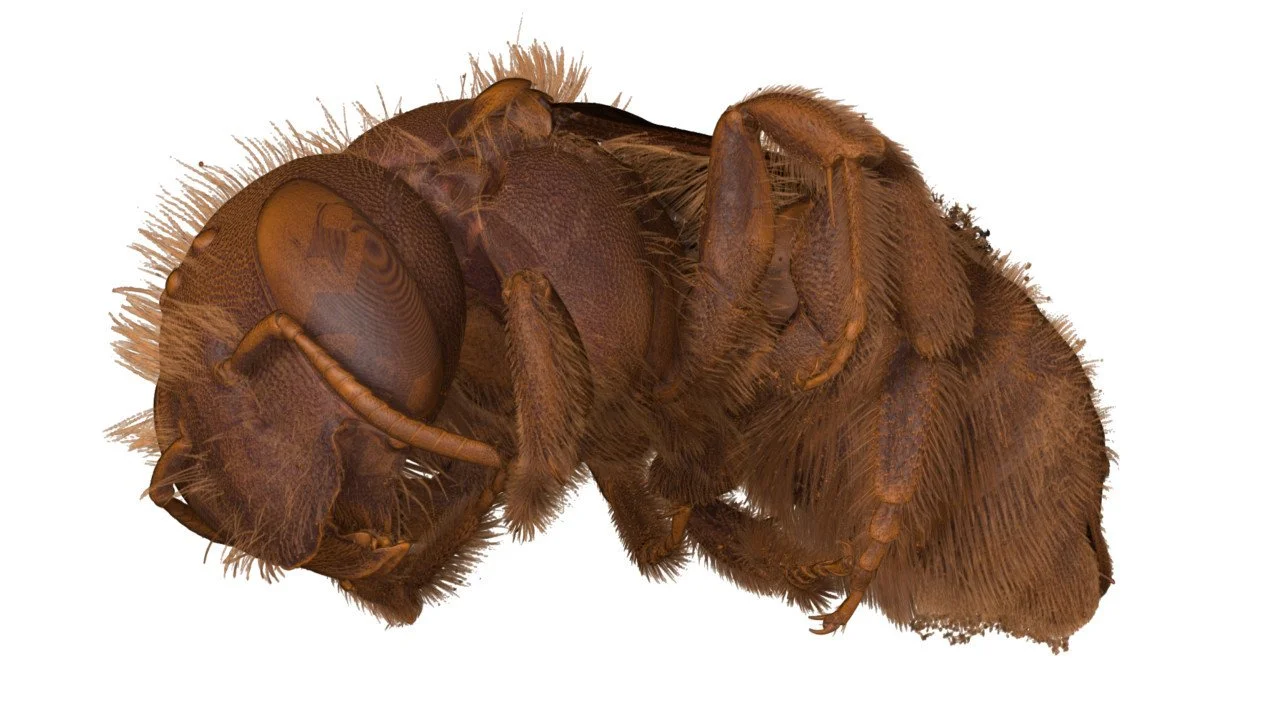

Explore the hidden anatomy of insects through award‑winning Micro‑CT scans—turning cutting‑edge research into explorable scientific discovery.

Exhibit at a Glances
Authentic research data – Real insect specimens captured using advanced micro‑CT, not illustrations or models
Explore the unseen – Reveals internal anatomy and structural detail invisible to the naked eye
Diverse insect species – Includes beetles, ants, bees, flies, and parasitic insects
Research to public engagement – Transforms specialist scientific data into intuitive, explorable learning experiences
Designed for education – Suitable for natural history museums, science centres, and public outreach environments
International access – Content designed for global audiences in education and public science communication
Featured in the exhibit
DUNG BEETLE (SCARABAEUS SP.)
Ancient Egyptians thought very highly of the scarab (from their taxonomic family name, Scarabaeidae). They believed the dung beetle kept the Earth revolving like a giant ball of dung, linking the insect to Khepri, the Egyptian god of the rising sun.
Data by Professor Javier Alba-Tercedor at University of Granada, Spain
MASSON BEE (OSMIA RUFA)
Mason bees are named for their habit of using mud or other "masonry" products in constructing their nests. Unlike honeybees or bumblebees, Mason bees are solitary; every female is fertile and makes her own nest, and no worker bees for these species exist.
Data by Professor Javier Alba-Tercedor at University of Granada, Spain
HUMAN LOUSE EGG (PEDICULUS HUMANUS CAPITIS)
A 3D scan of a human louse egg curated, scanned, and interpreted by Professor Javier Alba-Tercedor at the University of Granada, Spain.
Data by Professor Javier Alba-Tercedor at University of Granada, Spain
DESERT ANT (CATAGLYPHIS VELOX)
Desert ants are adapted to dry and hot habitats such as deserts. They are scavengers and feed on other insects which have succumbed to heat stress. Desert ants use their vision for navigating and the routes are stored in long-term memory.
Data by Professor Javier Alba-Tercedor at University of Granada, Spain
HOUSE FLY (MUSCA DOMESTICA)
The Housefly is the most common fly species found in habitations. House flies can carry many different pathogens, such as those causing typhoid, cholera, salmonellosis, and tuberculosis.
Data by Professor Javier Alba-Tercedor at University of Granada, Spain